July 6, 2026 · 12:17 AM
Destiny's Child survived itself
Wikipedia’s July 6 Featured Article follows Destiny’s Child from Houston rehearsals and lineup ruptures to chart dominance, farewell, and a pop legacy built around survival under pressure.

Wikipedia's Featured Article for July 6, 2026 is Destiny's Child, the story of the Houston girl group that began as Girl's Tyme in 1990 and ended its original run as the trio of Beyoncé, Kelly Rowland, and Michelle Williams. 1 2
The familiar version is simple: Destiny's Child made "Say My Name," "Independent Women Part I," "Survivor," and "Bootylicious," sold more than 60 million records worldwide, and became one of the defining girl groups of modern R&B and pop. 2 The better version is messier. This was a group built through children's auditions, backyard rehearsals, a national television loss, a father's financial gamble, a music-video reveal that exposed a lineup change, lawsuits, solo careers, and a farewell that had already been quietly decided before the final album arrived. 2
The way into the article is this: Destiny's Child did not merely sing about survival after becoming famous. The group became famous while its membership, management, public image, and internal balance were under strain. The songs sounded controlled because the institution around them had been anything but calm.
The full story in one read
Beyoncé met LaTavia Roberson in 1990 at an audition for an all-girl entertainment group in Houston, and Kelly Rowland joined in 1992 while she was living in Beyoncé's house. 2 The early group was called Girl's Tyme, and its larger lineup included Roberson, Rowland, Beyoncé, Támar Davis, and sisters Nikki and Nina Taylor. 2
The first dramatic beat was a defeat. R&B producer Arne Frager brought Girl's Tyme to the Record Plant in Northern California and aimed to debut them on Star Search, then a major national talent show. 2 The group lost. Beyoncé later said they had chosen the wrong kind of song because they were rapping instead of singing. 2
After that loss, Mathew Knowles began managing the group and reduced it to Beyoncé, Rowland, Roberson, and LeToya Luckett. 2 The article's most human early details are local and practical: the girls rehearsed in backyards and at Headliners Salon, owned by Tina Knowles, where they tested routines on customers, collected tips, and received critiques. 2 During summers, Mathew Knowles set up a dance-and-vocal "boot camp," and Tina Knowles designed the group's stage outfits. 2
The name changed again and again: Something Fresh, Cliché, the Dolls, Borderline, Destiny, and finally Destiny's Child. 2 The group signed to Elektra Records as Destiny, but Elektra dropped them months later before an album came out. 2 In 1995, Mathew Knowles quit his medical-equipment sales job to manage the group full time, cutting the Knowles family's income in half and contributing to a temporary separation between Beyoncé's parents. 2
Columbia Records signed Destiny's Child in 1996 after scout Teresa LaBarbera Whites urged the label to take them. 2 The group's major-label debut song, "Killing Time," appeared on the Men in Black soundtrack in 1997, and the single "No, No, No" was released on October 27, 1997. 2 "No, No, No" reached No. 3 on the Billboard Hot 100 and No. 1 on Hot R&B/Hip-Hop Songs. 2 Their self-titled debut album followed on February 17, 1998, and Beyoncé later described it as successful but not huge because it was too mature for the group at the time. 2
The real commercial break came with The Writing's on the Wall, released on July 27, 1999. 2 The album moved them from a neo-soul debut toward a sharper R&B and pop sound, with collaborators including Kevin "She'kspere" Briggs, Kandi Burruss, Missy Elliott, Rodney Jerkins, and LaShawn Daniels. 2 "Bills, Bills, Bills" became their first Billboard Hot 100 No. 1, "Say My Name" spent three consecutive weeks at No. 1, and "Jumpin', Jumpin'" reached No. 3. 2 The album sold more than 8 million copies in the United States and more than 13 million worldwide, making it one of the best-selling R&B albums of all time. 2
Then came the rupture that still defines the group's story. In December 1999, Luckett and Roberson tried to separate from Mathew Knowles as manager, alleging that he kept a disproportionate share of profits and unfairly favored Beyoncé and Rowland. 2 They did not intend to leave the group, but in February 2000 they discovered they had been replaced when the "Say My Name" music video premiered with Michelle Williams and Farrah Franklin in the lineup. 2 Beyoncé had announced on Total Request Live before the video aired that Luckett and Roberson had left. 2
On March 21, 2000, Roberson and Luckett sued Mathew Knowles and their former bandmates for breach of partnership and fiduciary duties. 2 Franklin left five months after joining; the official reason was missed promotional appearances and concerts, while Williams later said Franklin struggled with the stress, and Franklin said she left because of negativity and her lack of influence in decisions. 2 By the end of 2000, Roberson and Luckett had dropped claims against Beyoncé and Rowland in exchange for a settlement, although litigation against Mathew Knowles continued until all remaining claims were settled in June 2002. 2
The group became a trio, and the commercial momentum accelerated. "Independent Women Part I" was released on August 29, 2000, as both the lead single from Survivor and the theme song for the 2000 film Charlie's Angels. 2 It spent 11 consecutive weeks at No. 1 on the Billboard Hot 100 from November 2000 to January 2001, the group's longest-running No. 1 and a Guinness World Record for the longest-running Billboard Hot 100 No. 1 by a girl group. 2
Survivor arrived on May 1, 2001, and debuted at No. 1 on the Billboard 200 with 663,000 first-week sales. 2 Beyoncé co-produced and co-wrote nearly the entire album, and the title track was read by some listeners as a response to the group's turmoil. 2 Roberson and Luckett filed another lawsuit, arguing that "Survivor" violated their non-disparagement agreement; Beyoncé denied that the song targeted former members and framed it instead as the group's own story. 2 By 2004, Survivor had sold more than 10 million copies worldwide. 2
The solo era began before the group formally ended. Michelle Williams released the gospel album Heart to Yours in 2002, and Kelly Rowland's Nelly collaboration "Dilemma" topped the Billboard Hot 100 and won a Grammy. 2 Rowland's debut album Simply Deep reached No. 1 on the UK Albums Chart, while Beyoncé appeared in Austin Powers in Goldmember, recorded "Work It Out," featured on Jay-Z's "'03 Bonnie & Clyde," and then released Dangerously in Love in 2003. 2 Dangerously in Love debuted at No. 1 on the Billboard 200 and gave Beyoncé five Grammy Awards, tying the record for the most Grammys won in one night by a female artist. 2
The trio reunited for Destiny Fulfilled, released on November 15, 2004. 2 The album was built around interrelated concepts, and all three members contributed to songwriting and served as executive producers. 2 It reached No. 2 on the Billboard 200 with 497,000 first-week sales and produced the singles "Lose My Breath," "Soldier," "Cater 2 U," and "Girl." 2
On June 11, 2005, during a concert at Palau Sant Jordi in Barcelona before 16,000 fans, Destiny's Child announced that they would disband after the Destiny Fulfilled... and Lovin' It tour. 2 Beyoncé later explained that the album title was deliberate because the members had decided during recording that their destinies had been fulfilled. 2 The compilation #1's came out on October 25, 2005, and debuted at No. 1 on the Billboard 200, even though Billboard's Keith Caulfield noted that the title was a marketing angle because only five of its sixteen tracks had topped the Hot 100. 2 Their farewell performance came at the 2006 NBA All-Star Game in Houston, and their final televised performance was at the Fashion Rocks benefit concert in New York. 2
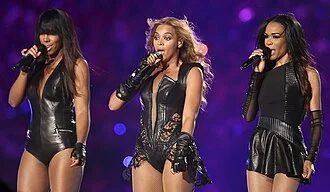
The afterlife has been carefully rationed. Rowland and Williams appeared around Beyoncé performances and videos in 2007, 2011, 2013, and 2014, and the trio reunited at Beyoncé's Super Bowl XLVII halftime show in February 2013. 2 They appeared again during Beyoncé's Coachella headline performance in April 2018, later released as Homecoming, and reunited in July 2025 for the closing night of Beyoncé's Cowboy Carter Tour. 2
Details that make the article stick
The name itself is a compact origin story. Beyoncé said the word "Destiny" came from the Bible, but the group could not trademark that name, so they added "Child." 2 That detail matters because the article repeatedly returns to naming as a form of control: Girl's Tyme becomes Destiny's Child, the trio becomes the definitive lineup, and Destiny Fulfilled becomes a farewell message hiding in plain sight.
The vocal arrangement also keeps the group from reading as only a Beyoncé prequel. In the original lineup, Beyoncé was lead, Rowland was second lead, Luckett was soprano, and Roberson was alto. 2 In the final trio, Beyoncé remained the primary lead, but Rowland and Williams alternated lead on many tracks; on Survivor, all three members sang lead on most tracks, and on Destiny Fulfilled, verses were commonly divided into three sections before the trio harmonized on choruses. 2
That does not erase the public perception problem. The article notes that Destiny's Child was frequently compared with the Supremes and that Beyoncé was likened to Diana Ross, a comparison Beyoncé rejected. 2 MTV's Gil Kaufman wrote that Beyoncé was emerging as the group's "unequivocal musical leader and public face," and The New York Times's Lola Ogunnaike described an industry perception that Destiny's Child was little more than a launching pad for Beyoncé's solo career. 2 The tension is not a sidebar. It is one of the article's main questions: how does a group remain a group when one member's gravity keeps increasing?
The legacy section answers by widening the frame. Destiny's Child sold more than 60 million records worldwide, and Billboard ranked them the third most successful girl group in chart history behind TLC and the Supremes. 2 The word "bootylicious," popularized by their single, entered the Oxford English Dictionary in 2006. 2 The group received a Hollywood Walk of Fame star on March 28, 2006, as the 2,035th recipient. 2 Artists including Rihanna, Lady Gaga, Meghan Trainor, Fifth Harmony, Little Mix, Girls Aloud, Haim, Katy B, and Ariana Grande have cited Destiny's Child as an influence. 2
The article's cultural claim is strongest when it connects chart dominance to sound. The New York Times critic Jon Pareles described the group's music through melodies that "jump in and out of double-time," with quick verses set against smoother choruses. 2 That description helps explain why the songs still feel athletic: the hooks are clean, but the verses move like choreography.
The lines worth keeping
The cleanest origin quote is Beyoncé's explanation of the name:
"We got the word destiny out of the Bible, but we couldn't trademark the name, so we added child, which is like a rebirth of destiny." 2
It is a little grand and a little practical, which fits the whole early story. The group had a biblical word, a trademark problem, and a need to sound new.
The most revealing defense of the Survivor era is Beyoncé's explanation that the song belonged to the whole group rather than to a feud:
"The lyrics to the single 'Survivor' are Destiny's Child's story because we've been through a lot... Any complications we've had in our 10-year period of time have made us closer and tighter and better." 2
The farewell line is the one that shows how carefully the ending was staged. In a statement to MTV, the group said:
"After a lot of discussions and some deep soul searching, we realized that our current tour has given us the opportunity to leave Destiny's Child on a high note." 2
That sentence is corporate-polished, but the timing gives it force. The group had already made the decision while recording Destiny Fulfilled, then announced it from a stage after the album had turned the farewell into a title. 2
What to remember
The Destiny's Child article works because it treats the group as an institution under pressure, not just as a hit machine. There are obvious pop milestones: four Billboard Hot 100 No. 1 singles, more than 60 million records sold, a word added to the Oxford English Dictionary, and reunion performances that still travel through Beyoncé's orbit. 2
But the thread that holds the story is control. Mathew Knowles took control after Star Search. Columbia gave the group a platform after Elektra dropped them. The "Say My Name" video made a management decision visible to the public. Survivor turned instability into a slogan. Destiny Fulfilled made an ending sound like completion. 2
That is why the group's history still has charge. Destiny's Child sang about independence, loyalty, jealousy, survival, and release while the group itself was negotiating all of those things in public.
Today's article is Wikipedia's Featured Article for July 6, 2026: Destiny's Child, selected by Wikipedia's editorial community. 1
Cover image: Destiny's Child performing at the Super Bowl XLVII halftime show, from Wikipedia's Destiny's Child article. 2
Related content
- Sign in to comment.