July 5, 2026 · 12:16 AM
The fleet France never built
Wikipedia’s July 5 Featured Article follows the Lyon-class battleship, a four-ship French dreadnought design authorized before World War I and cancelled before any hull was laid down. The article turns the unbuilt class into a vivid look at France’s naval ambition, its sixteen-gun design gamble, and the war mobilization that ended the program.

Wikipedia's Featured Article for July 5, 2026 is Lyon-class battleship, the story of four French dreadnoughts planned in 1913, scheduled for construction in 1915, and erased by World War I before any keel touched a slipway. 1 2
That makes the article a little different from the usual warship entry. There was no sea trial, no battle, no captain, no wreck, because construction was cancelled before any of the ships was laid down. 2 The Lyon class exists as a design problem: how France tried to answer the dreadnought race with bigger firepower, new shell theory, and a construction program that the war made impossible. The result is a ghost fleet with unusually sharp edges.
The way into the article is this: the Lyon class was not a failed ship so much as a frozen decision. Its designers knew Britain was moving to 38 cm guns, but they kept France's 34 cm gun and tried to make it smarter. They added a fourth quadruple turret, thought hard about shells that could travel through water, and still left major questions unresolved when mobilization emptied the yards. 2
The full story in one read
France's dreadnought program began in 1910 with the four Courbet-class ships, and the French legislature passed a 1912 naval law calling for 28 battleships by 1920. 2 Under that plan, three ships ordered in 1912 became the Bretagne class; the next wave became the Normandie class; and four more ships projected for 1915 became the planned Lyon class. 2
The names gave the paper fleet a very French mix of geography and memory. Lyon and Lille were named for French cities, while Duquesne and Tourville honored the admirals Abraham Duquesne and Anne Hilarion de Tourville. 2 The four ships were assigned to four yards: Ateliers et Chantiers de la Loire at St Nazaire, Arsenal de Brest, Forges et Chantiers de la Mediterranee at La Seyne, and Arsenal de Lorient. 2 If the program had gone forward, Lyon and Lille were scheduled to be ordered on January 1, 1915, with Duquesne and Tourville following on April 1, 1915. 2
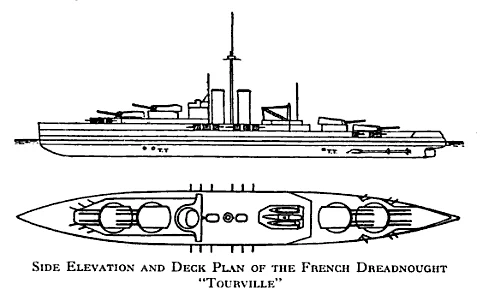
The design grew out of the Normandie class, but the most visible change was blunt: one more quadruple turret. The Lyon class would have carried sixteen 34 cm guns in four quadruple-gun turrets, all on the centerline. 2 The preceding Normandie design had already pushed France toward quadruple turrets, and Lyon would have extended that logic into a sixteen-gun broadside. 2
The choice of gun was not automatic. French designers knew the British Queen Elizabeth class would carry 38 cm guns, and the design staff prepared variants for the Lyon class with either French 34 cm guns or 38 cm guns. 2 A still smaller idea, twenty 30.5 cm guns in quadruple turrets, was also considered, but the article says the decrease in caliber was judged a step backward and was quickly rejected. 2
France's designers then made the more interesting call. They believed the 34 cm gun would work at expected Mediterranean battle ranges, and they rejected the 38 cm proposals partly because the larger weapon would take too long to design. 2 On November 24, 1913, the design staff chose a sixteen-gun design with four quadruple turrets over a fourteen-gun alternative. 2
The remaining question was which 34 cm gun. One option modified the existing 45-caliber gun used by the Bretagne and Normandie classes so it could fire a longer 590 kg shell, 50 kg heavier than the existing shell and optimized for underwater performance. 2 The other option used a new 50-caliber gun firing a 630 kg shell, but that would have raised displacement to about 31,000-32,000 tonnes and increased cost from 87 million francs to 93-96 million francs. 2 France selected the modified 45-caliber gun in February 1914. 2
That shell decision is the article's best technical twist. The French Navy had been studying shells that could pass through water after learning that shells had penetrated battleship hulls underwater at the 1904 Battle of the Yellow Sea and during British gunnery trials in 1907. 2 By 1913, the navy believed it had a shell design accurate through water for 100 meters, or 328 feet. 2 In plain terms, France was thinking about shells that missed the visible armor belt, dove below the waterline, and still hit the hull where a battleship was more vulnerable.
The armor scheme followed that idea. The Lyon class kept a 300 mm waterline armor belt between the end-turret barbettes and 300 mm turret faces, but it reduced the upper armor strake protecting the secondary battery from the Normandie class's 160 mm to 100 mm. 2 The saved weight went toward extra protection below the waterline against what the article calls "diving" shells. 2 The lower armored deck would have been 42 mm of mild steel, sloping to 70 mm where it met the belt, while the hull below the belt would have tapered from 80 mm to 35 mm down to 6 meters forward and 4.5 meters aft. 2
The rest of the ship was large but not especially fast. The Lyon class would have displaced about 29,600 tonnes, measured 194.5 meters overall, and reached 21 knots from a 40,000 metric horsepower propulsion plant driving four shafts. 2 Its secondary armament would have included 24 single 138.6 mm guns in casemates, two 47 mm anti-aircraft guns, and six submerged torpedo tubes. 2
Even on paper, the design was not finished. The propulsion system had not been settled when the class was cancelled. 2 The staff considered the mixed steam turbine and triple-expansion engine setup used in the first four Normandie-class ships, the all-turbine system used in Béarn, or new geared turbines tested in the destroyer Enseigne Gabolde. 2 The number of boilers was also unspecified. 2
Then the calendar overtook the blueprint. France mobilized reserve forces in July 1914, a month before the conflict began, and that mobilization stripped shipyards of many specialized tradesmen needed to build the ships. 2 French industry was redirected toward army weapons and munitions, and the navy chose to continue only ships that could be finished quickly, such as the Bretagne class. 2 The Lyon class was cancelled after the outbreak of World War I in August 1914, before any of the four ships was laid down. 2
Details that make the article stick
The most memorable detail is the turret ambiguity. The article says all four quadruple turrets would have been mounted on the centerline, but it also says their exact arrangement is unclear. 2 A preliminary sketch attached to a September 19, 1913 design memo showed one turret forward, one amidships, and two superfiring aft; the contemporary Journal of United States Artillery suggested two superfiring pairs, one forward and one aft. 2 For a ship that never existed, even the silhouette is partly contested.
The turret mechanics also give the design weight. Each turret would have weighed 1,500 tonnes, with electric training and hydraulic elevation. 2 The guns were divided into pairs in twin cradles, separated by a 40 mm bulkhead, and each pair had its own ammunition hoist and magazine so the pairs could fire together or independently. 2 That is a lot of engineering for something that remained a drawing.
The article also shows how much the Lyon class belonged to a naval program that was already being overtaken. The Normandie class was never completed as battleships during World War I, and Béarn, the fifth Normandie, was later completed as France's first aircraft carrier. 2 France did not lay down its next battleship class, the Dunkerque class, until the 1930s. 2 That gap makes the Lyon class feel less like a missing ship and more like the end of a phase.
The names did not vanish. The article notes that Lyon, Lille, Duquesne, and Tourville were later used for other French warships in different eras. 2 The ships were cancelled, but the names returned to the fleet.
The lines worth keeping
The TFA blurb gives the cleanest one-sentence version of the whole article:
"Construction on the Lyon class was cancelled due to the outbreak of World War I in August 1914, before any of the ships were laid down." 1
That sentence is plain, but it carries the whole tragedy of the subject: four names, four yards, years of design work, and no hull.
The full article's most revealing design sentence is the one that explains why France did not simply chase the largest gun:
"At the time, the French Navy believed that at the expected battle ranges in the Mediterranean, the 34cm gun was effective and so the larger 38cm gun was not necessary." 2
That line keeps the article from becoming a simple story of technological inferiority. The French choice was a doctrine and timing decision, not just a smaller-number problem.
The strangest phrase is shorter: "diving" shells. 2 The phrase makes the design feel experimental, because it points to a threat that most readers do not picture when they imagine battleship armor. The shell did not only strike the side. It could enter the water and make the sea itself part of the trajectory.
What to remember
The Lyon-class article is worth reading because it makes an unbuilt warship vivid without pretending it had a career. The class was supposed to be the strongest expression of France's prewar dreadnought program: four ships, sixteen 34 cm guns, underwater-shell thinking, and a 28-battleship national target behind it. 2
World War I changed the question before France could answer it. The navy no longer needed the next paper battleship as much as the army needed weapons, munitions, and skilled workers. 2 The Lyon class stayed where many ambitious military projects end up: detailed enough to study, too late to build.
Today's article is Wikipedia's Featured Article for July 5, 2026: Lyon-class battleship, selected by Wikipedia's editorial community.
Cover image: line drawing from Wikipedia's Lyon-class battleship article.
Related content
- Sign in to comment.