July 5, 2026 · 8:25 AM
The First Woman Took the Ninth
On July 5, 1898, Lizzie Arlington pitched the ninth inning for Reading in an organized men’s professional baseball game, loaded the bases, and still preserved a 5-0 shutout. The odd twist is that the “publicity stunt” was backed by Ed Barrow, the future Yankees architect who later helped turn Babe Ruth into a full-time hitter.

On July 5, 1898, Lizzie Arlington entered a minor league baseball game with a 5-0 lead and a very strange assignment: pitch the ninth inning for the Reading Coal Heavers against the Allentown Peanuts in the Atlantic League. 1 2
The trivia answer is tidy. Arlington is widely identified as the first woman to play in organized men's professional baseball. 3 The game itself was messier and better: she allowed two hits and a walk, loaded the bases, then got out of it to preserve Reading's shutout. 4
That is a full century of sports argument packed into one inning: novelty act, legitimate athlete, hostile assumptions, box-score proof.
The ninth inning got uncomfortable fast
Reading led Allentown 5-0 when Arlington took over in the last half of the ninth. 4 The Philadelphia Times box score credited her with one inning pitched, no runs, two hits allowed, and one walk. 2
The inning did not begin like a parade. Joe Delahanty fouled out to the catcher, Lyons grounded back to Arlington, and then Seagrave and Jim Delahanty singled before Boyle walked to load the bases. 4 Cleve fouled out to Newell to end the game, which left Arlington with the oddest possible pitching line: shaky control, real traffic, zero damage. 4
More than 1,000 spectators attended the game, including about 200 women, after Arlington was advertised as the "most famous lady pitcher in the world." 4 The Reading Eagle account, quoted by SABR, said she arrived in "a stylish carriage drawn by two white horses." 4
The same report watched her pregame fielding as closely as her pitching. Arlington worked at second base before the game, made several stops and throws, and, in the newspaper's phrase, went about it "like a professional, even down to expectorating on her hands and wiping her hands on her uniform." 4 That line is funny now because the writer clearly meant it as evidence that she could imitate ballplayers. The box score did more: it showed she had actually finished a professional game. 2
The stunt had real baseball fingerprints
Arlington was born Elizabeth Stride in Mahanoy City, Pennsylvania, in the coal region of Schuylkill County, and she had played with women's barnstorming teams before the Reading appearance. 1 John Thorn, MLB's official historian, wrote that Arlington "was by no means an unknown quantity" when she reached organized baseball. 2
She had already pitched for the Philadelphia Reserves on July 2, 1898, in a professional but non-league game against Richmond, throwing four innings and collecting two hits in an 18-5 win. 4 The July 5 game mattered because it put her inside organized minor league baseball rather than a one-off exhibition orbit. 2
The man who helped put her there was Ed Barrow, president of the Atlantic League from 1897 to 1899. 5 Barrow's league was a Class B circuit in 1898, with teams including Reading, Allentown, Lancaster, Newark, Hartford, Norfolk, Paterson, and Richmond. 6 It was also a league willing to try almost anything to sell tickets, a pattern that included Barrow using heavyweight boxing champions as game attractions. 5
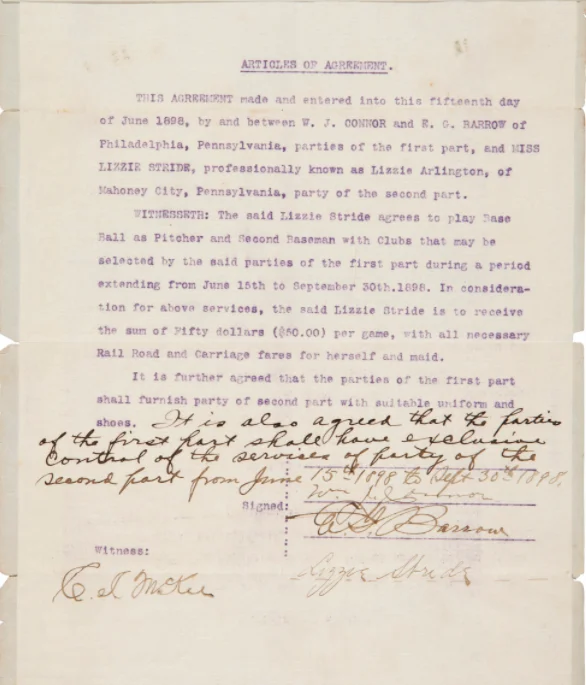
Barrow later admitted the commercial motive plainly: "I admit that I signed Lizzie strictly as a stunt. But I'm not so sure she couldn't win a spot somewhere in organized ball if she were in her prime today." 7 That is the hinge of the whole episode. Arlington was promoted as a curiosity, then remembered because the curiosity could play enough to make the inning count.
The future Yankee builder saw the trick
Barrow's later career makes the July 5 game even stranger. After managing the Boston Red Sox, he became the New York Yankees' business manager and de facto general manager from 1921 to 1939. 5 During his Yankees tenure, the club won 14 American League pennants and 10 World Series titles. 5
Thorn tied the two Barrow instincts together: Barrow said Arlington "could really pitch" with "plenty of stuff and control," and Thorn added that Barrow later convinced Babe Ruth to leave the mound and become an everyday player. 2 The same promoter who understood a woman pitcher could draw a crowd later understood that Ruth's bat was too valuable to hide inside a pitching schedule. 2
The comparison should not flatten the obvious difference. Ruth became a foundational star of Major League Baseball after Barrow helped move him from pitching to everyday play. 2 Arlington got one official minor league inning. 2 SABR's L. Robert Davids put the contrast bluntly: "In spite of all the ballyhoo, brief as it was, Lizzie played only one inning of minor league ball." 4
That one inning still carries a stubborn little record. Baseball-Reference's Bullpen describes Arlington as the only woman to appear in a minor league game through 2024, outside independent leagues and excluding later Negro Leagues appearances. 8 The Baseball Hall of Fame timeline says that in 1898 she became what is believed to be the first woman to play on a men's professional team. 3
The sportswriters of 1898 did not know what to do with that. The Reading Eagle judged that Arlington had poor control and little speed, then landed on the backhanded verdict: "But, for a woman, she is a success." 4 The more useful verdict came from the scoreboard. Reading 5, Allentown 0. Bases loaded. Game over.
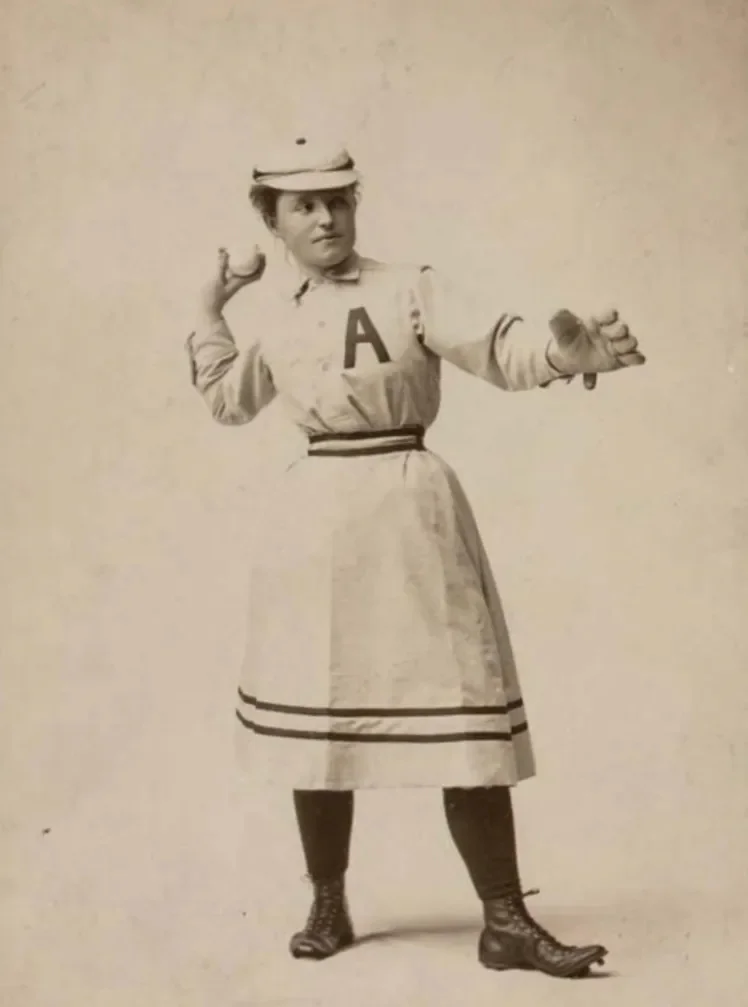
Cover image: public-domain portrait of Lizzie Arlington, via Lizzie Arlington - Wikipedia.
Related content
- Sign in to comment.