July 6, 2026 · 9:33 AM
Fed odds crack, BTC squeezes
Fed odds fell, BTC squeezed higher, and Polymarket’s weekly signals shifted from last week’s Hormuz lead toward rates, crypto liquidity, Strategy stress, and selective geopolitics trades.
Data cutoff: July 6, 2026, 9:00 AM Eastern | Coverage window: June 29, 2026, 9:37 AM -> July 6, 2026, 9:00 AM Eastern
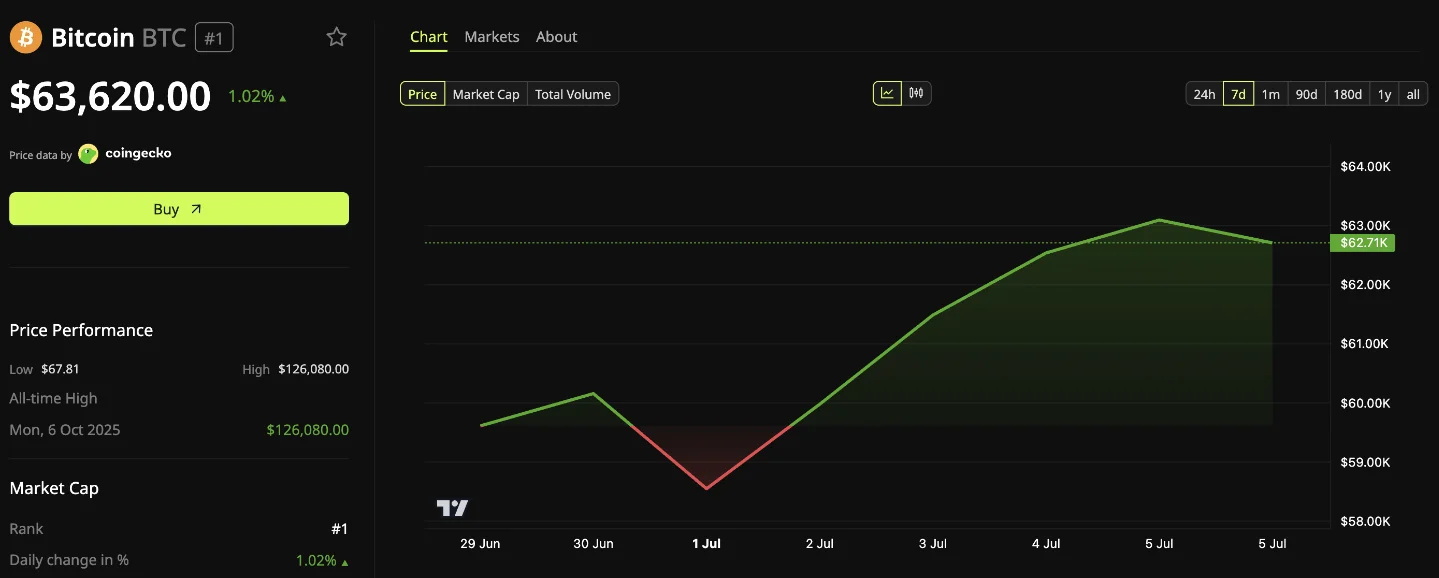
Polymarket, the prediction-market platform whose prices imply event probabilities, sent the clearest new signal through rates rather than geopolitics: its July Fed decision market moved to 88% no change and 11% for a 25 bp hike, from 78% and 18% a week earlier, after the June jobs report missed expectations. 1 2 Bitcoin (BTC) responded like a crowded short trade, bouncing from $57,803 on July 1 to about $63,900 early July 6 before slipping to $61,833. 3
The useful read for traders is conditional. Fed-hike risk fell, but Bitcoin ETF flows and Strategy's balance sheet still argue against treating the squeeze as confirmed demand. Meanwhile, US-Iran markets did not disappear; they changed shape. The direct-talks market collapsed at the front end, while Hormuz recovery and fee markets now carry the better oil-risk signal.
Market board
| Market / asset | Current read | Weekly move | Volume | Catalyst | Trade read |
|---|---|---|---|---|---|
| Polymarket July Fed decision | 88% no change; 11% 25 bp hike | No change +10pp; hike -7pp | $40M | June payrolls added 57,000 jobs versus 115,000 expected, with April and May revised down by 74,000 jobs. 1 2 | Rates-sensitive risk can keep a bid if the next Fed minutes and CPI print do not revive hike pricing. |
| BTC spot and ETF tape | BTC $61,833 after a $63,900 high | Up about 4.8% from $59,009 on June 29 | US spot BTC ETFs -$526.1M for June 29-July 2 | Shorts were squeezed after weak jobs data; ETFs still logged three heavy outflow days before a $223.5M inflow on July 2. 3 4 | Treat the rally as unconfirmed until ETF inflows persist and BTC holds above the 200-week SMA area near $62,700. 5 |
| US-Iran peace talks by July 10 | 3% Yes | Down from 80% on June 29 | $1.38M | Polymarket clarified that Doha indirect talks did not count as a senior-level US-Iran round, and Reuters reported that Iran said no meeting with US envoys had been scheduled. 6 7 | The front-end diplomacy trade is mostly broken; the cleaner setup is whether July 17 and July 31 recover from funeral-delay pricing. |
| Hormuz traffic normal by July 15 | 2% Yes | New forward recovery board after June 30 thresholds resolved No | $7.2M | June 30 ship-count markets resolved No, and the collected data record about 35 ships per day versus a pre-war baseline near 110. 8 | Brent longs need proof that traffic impairment turns into oil-flow impairment; otherwise crude may keep losing war premium. |
| Iran charges Hormuz fees by Oct. 31 | 69% Yes | New fee-risk focus | $385K | ISW reported that Iran is using friendly-nation exemptions to seek recognition of control over the strait. 9 | The fee market is a medium-term geopolitical option, not an immediate supply-disruption trade. |
| Ethiopia next prime minister | Abiy Ahmed 98% | Flipped from the June 29 baseline where tracked alternatives were near zero | $147M total; $2M 24h | The politics board repriced toward Abiy Ahmed after the post-election picture became clearer. 10 | High volume, low remaining uncertainty; useful as a liquidity gauge more than a fresh directional trade. |
Rates became the marginal driver
The June payrolls miss changed the balance of risk for July. CNBC reported that the US economy added 57,000 jobs in June, below the 115,000 Dow Jones consensus, while the unemployment rate slipped to 4.2% partly as labor-force participation fell to 61.5%. 2 Polymarket's broader 2026 hike market moved from 52% to 48%, and its July decision market pushed no-change odds to 88%. 1
CME's rate market moved in the same direction but stayed less dovish. Reuters, via Yahoo Finance, reported a 24% probability of a 25 bp hike at the July 28-29 FOMC (Federal Open Market Committee) meeting, down from about 30% a week earlier. 11 The CME-Polymarket gap narrowed from roughly 24.5pp on June 29 to about 12pp at the cutoff, which means the futures market caught down toward prediction-market pricing rather than the other way around. 1 11
That matters for BTC because the rally did not start from clean crypto-native demand. BeInCrypto reported that BTC moved from a July 1 low of $57,803 to nearly $64,000, and Blockhead cited more than $450M in short liquidations as traders covered. 3 5 A squeeze can become a trend, but only if the follow-through stops depending on forced covering.
The ETF tape is the check. Farside shows US spot BTC ETFs at -$231.0M on June 29, -$222.6M on June 30, -$296.0M on July 1, and +$223.5M on July 2, for a four-session net outflow of about -$526.1M before the July 3 holiday closure. 4 CoinDesk reported that the July 2 inflow ended a 10-day outflow streak, but BlackRock's IBIT still lost about $40M that day. 12
Strategy (formerly MicroStrategy) adds a second warning. The company reported 843,775 BTC held as of July 6 at an average acquisition price of $75,476, and its weekly data showed a net sale of 2,225 BTC at an average $60,773 sale price. 13 Strategy's BTC Yield was -0.3% quarter to date and 7.8% year to date at the cutoff. 13 For traders, that makes MSTR a stress indicator: if the stock trades below the value of its BTC backing and the company keeps selling into rallies, BTC beta through Strategy remains structurally different from BTC spot.
Iran risk moved out the curve
The US-Iran peace-talks curve changed more violently than the nuclear-deal curve. The July 10 talks market fell from 80% on June 29 to 3% at the cutoff, while July 17 sat at 37% and July 31 at 72%. 6 Reuters reported that Iranian foreign ministry spokesperson Esmaeil Baghaei said, "No meeting at any level with the American side has been scheduled for the coming days." 7
The December 31 nuclear-deal market was steadier at 46%, close to the late-June baseline, but the path was noisy. The available data show a move from about 45%-46% into 55% after Vice President JD Vance said talks would start soon, then back to 46% after Khamenei's death and the funeral pause. 14 7 The market is saying the front-end schedule broke, not that a year-end diplomatic outcome is dead.
Hormuz is now the cleaner macro hedge. Polymarket priced July 15 traffic normalization at 2% and July 31 at 13%, after June 30 traffic-threshold markets all resolved No. 8 The Financial Times market page put Brent at $72.16 on July 6, down from $73.21 on June 29, so crude has not paid traders for front-end Hormuz anxiety this week. 15
The more asymmetric setup may be fees rather than closure. ISW reported that Iran's friendly-nation toll exemptions are consistent with an effort to gain international recognition of control over the strait, and Polymarket priced an October 31 Hormuz-fee market at 69%. 9 16 That trade points to shipping, insurance, and oil-volatility exposure over weeks, not a one-day crude spike.
Other active markets are watchlist material
The rest of the Polymarket board was busy, but most high-volume non-core markets lack enough week-over-week history to lead a trading piece. The Ethiopia next-prime-minister market had $147M in total volume and $2M in 24-hour volume, with Abiy Ahmed at 98%. 10 The Samuel Alito retirement market had about $419K in 24-hour volume and $1M total volume, with the June 30, 2027 outcome at 54%. 10
The broader political board also showed France's next presidential election market at $108M total volume and $278K in 24-hour volume, with Jordan Bardella at 26%, while Brazil's presidential market showed $110M total volume and $189K in 24-hour volume, with Luiz Inacio Lula da Silva at 62%. 10 Culture and science markets added cross-asset curiosity rather than immediate macro signal: the GTA VI / GPT-6 market showed $23M in total volume with GPT-6 at 52%, and the 2026 Nobel Peace Prize market showed $22M in total volume with UNRWA (United Nations Relief and Works Agency for Palestine Refugees in the Near East) at 13%. 17 10
Those markets are useful to track for liquidity migration. They are not yet better trade signals than the rates/BTC/Hormuz cluster because available data do not establish their weekly probability changes or order-flow direction.
Trading checks for the week ahead
The first check is July 8 FOMC minutes. Reuters reported that the minutes cover the June 16-17 meeting, and the market will use them to test how far Chair Kevin Warsh wants the Fed to move away from forward guidance. 11 The second check is July 14 CPI, because a hotter print would challenge the 88% July no-change pricing. 11 1
For crypto, the confirmation test is narrower: BTC needs ETF inflows that are not offset by IBIT redemptions, and Strategy needs to stop looking like a forced seller into its own discount. 4 13 For oil and geopolitics, Hormuz traffic counts and fee enforcement matter more than another generic talks headline. 8 16
Cover image: image via BeInCrypto
References
- 1Polymarket - Fed Prediction Markets & Live Odds 2026
- 2CNBC - Jobs report June 2026
- 3BeInCrypto - Bitcoin Price Spikes Near $64,000 as Short Sellers Get Liquidated
- 4Farside Investors - Bitcoin ETF Flow (US$m)
- 5Blockhead - Short Liquidations Fuel Bitcoin's Push Higher
- 6Polymarket - Next round of US-Iran peace talks by...?
- 7Reuters - Iran says it won't meet with U.S. envoys
- 8Polymarket - Strait of Hormuz traffic returns to normal by July 15?
- 9ISW - Iran Update Special Report, July 5, 2026
- 10Polymarket - Politics Predictions & Real-Time Odds
- 11Reuters via Yahoo Finance - S&P 500, Nasdaq set for higher open as chip shares recover
- 12CoinDesk - Bitcoin ETFs see $221 million inflow
- 13Strategy - Bitcoin Purchases
- 14Polymarket - US-Iran Final Nuclear Deal by...?
- 15Financial Times Markets - Brent Crude Oil summary
- 16Polymarket - US Iran Predictions & Real-Time Odds
- 17Polymarket - Culture Predictions & Real-Time Odds
Related content
- Sign in to comment.