July 5, 2026 · 6:29 PM
AI Leaders Weekly: Equity Politics
This week’s issue argues that AI leadership discourse shifted from benchmark competition toward state alignment, access control, and infrastructure politics. It contrasts Altman’s proposed public-equity bargain with Anthropic’s safeguards-and-redeployment path, then places Huang, Mistral, Meta, xAI, DeepMind, LeCun, and SSI into the same strategic frame for AI strategists and PMs.

This issue covers June 28, 6:00 p.m. to July 5, 6:00 p.m. Pacific.
This week's governing signal was not a new benchmark race. It was a shift in how AI leaders are negotiating power around frontier systems. Sam Altman, OpenAI's CEO, floated a public-equity bargain with the US government. Anthropic, led by CEO Dario Amodei, turned last week's export-control crisis into a controlled redeployment, a jailbreak-severity framework, and two product launches. Jensen Huang, NVIDIA's founder and CEO, split his message across Washington-friendly manufacturing language and China-market reassurance.
For AI strategists and PMs, the practical read is direct: model quality still matters, but access terms, political alignment, deployment permissions, and infrastructure supply are becoming product variables. A frontier model may be strongest in a benchmark and still be constrained by export controls, trusted-partner lists, customer eligibility, or energy and supply-chain capacity.
| Leader | This week's usable signal | Strategic read |
|---|---|---|
| Sam Altman, OpenAI CEO | Altman proposed giving the US government a 5% OpenAI stake, reportedly worth about $42.6 billion at an $852 billion valuation, but only if Anthropic, Google, Meta, and other leading AI developers also contributed 5% stakes to a sovereign-wealth-fund-style vehicle. 1 2 | OpenAI is trying to convert political exposure into a shared public-upside structure, while making peer participation a condition. |
| Dario Amodei, Anthropic CEO | Anthropic said US export controls on Fable 5 and Mythos 5 were lifted on June 30; Fable 5 returned globally on July 1, while Mythos 5 access remained limited to selected US organizations. 3 | Anthropic is presenting safety review and partial access as an operational release pattern, not a founder-led media campaign. |
| Jensen Huang, NVIDIA CEO | Huang credited President Trump for US AI-chip manufacturing in a July 2 Fox News interview, while also praising China's AI ecosystem in state-media-covered CISCE remarks and citing more than 1.6 million Chinese developers building on NVIDIA. 4 5 | NVIDIA is managing a two-front message: domestic industrial policy in the US, continued developer and market relevance in China. |
| Arthur Mensch, Mistral AI CEO | Mensch said Mistral has an open-weight model coming this summer, with early access opening in July; TechCrunch also reported that Mistral is seeking about $3.5 billion at an approximately $23 billion valuation. 6 | Mistral is positioning open-weight access as the counterpoint to public-equity and controlled-access models, while its reported funding remains a reported claim rather than a company filing. |
| Alexandr Wang, Meta Superintelligence Labs chief | Wang reportedly told a July 2 Meta town hall that the next model, Watermelon, had caught up to OpenAI GPT-5.5 on important benchmarks and used an order of magnitude more compute than Avocado. 7 | Meta's public signal is internal acceleration, but the evidence is still reported internal commentary rather than public model access. |
| Elon Musk, xAI founder | Musk posted "Done with Grok Imagine" on July 5; xAI had already announced Voice Agent Builder on July 1. 8 9 | xAI's strongest signal is product surface expansion, not a detailed model-performance disclosure this week. |
Altman chooses the equity route
Altman's proposal was the week's clearest attempt to redefine the relationship between a frontier lab and the state. CNBC, TechCrunch, The Guardian, Axios, Ars Technica, and TIME all reported versions of the same basic structure: OpenAI would give 5% of its equity to the US government through a public-wealth-fund-style mechanism, but only if peer labs made the same 5% contribution. 1 10 11
The condition matters. Altman was not simply volunteering OpenAI equity. The proposal reportedly depended on Anthropic, Google, Meta, and other leading AI developers also giving 5%, which would turn the public stake into an industry-wide bargain rather than a unilateral concession. 1 2 CNBC reported that the 5% OpenAI stake would be worth about $42.6 billion based on an $852 billion valuation. 1
Altman's July 1 Financial Times op-ed supplied the governance half of the same argument. Fortune, Business Insider, SiliconAngle, and Gizmodo reported that Altman called for a "U.S.-led international forum" to set accepted standards, analyze capabilities and risks, and make technology available to countries and companies that participate and follow the rules. 12 13 Business Insider reported Altman's claim that AI will reshape the material conditions of human life at a scale not seen since electricity, and that OpenAI expects systems with "astonishing power" within another year or two. 14
The market-facing and state-facing pieces fit together. OpenAI's public story this week was not only about sharing upside. It was about giving elected governments a formal role in rules, access, and economic participation before the next capability jump arrives. That does not mean the proposal will happen. The Financial Times account described the talks as conceptual and early, and several reports noted that a deal of this kind could need congressional approval. 10 11
The political response already shows why the idea is volatile. CNBC's July 2 Oval Office interview asked President Donald Trump about a possible 5% OpenAI stake; Trump did not answer directly and instead talked about an Intel investment, saying, "I can solve your problem, but I want 10% of the company." 15 Ars Technica reported that Senator Bernie Sanders had pushed a much larger public-ownership approach, including a one-time 50% tax on the largest AI companies' stock to create a roughly $7 trillion sovereign wealth fund. 16
Anthropic chooses safeguards and controlled deployment
Anthropic's week had the opposite communication posture. Amodei did not use a personal account to sell a grand bargain. Anthropic used company channels to announce that export controls on Claude Fable 5 and Mythos 5 had been lifted as of June 30, that Fable 5 would return globally on July 1, and that Mythos 5 had been restored only for selected US organizations after US government approval on June 26. 3 CNBC also reported the June 30 lifting of export controls. 17
Anthropic paired the redeployment with a process answer. The company said it had trained an improved safety classifier and that US Commerce Department CAISI testing found both old and new classifiers "very strong." 3 Anthropic also said it was working with Amazon, Microsoft, Google, and other Glasswing partners on a consensus framework for AI jailbreak severity. 3 The detailed July 2 framework proposed Cyber Jailbreak Severity levels from CJS-0 to CJS-4 and scored incidents on capability gain, breadth of capability gain, ease of weaponization, and discoverability. 18
The product cadence was also heavy. Anthropic launched Claude Sonnet 5 on June 30, called it the most agentic Sonnet model yet, and priced the introductory period at $2 per million input tokens and $10 per million output tokens through August 31, with standard pricing of $3 and $15 afterward. 19 The same day, Anthropic launched Claude Science in beta as an AI workbench for scientists, with more than 60 preconfigured skills and connectors across genomics, single-cell analysis, proteomics, structural biology, and cheminformatics. 20
The legal record made Anthropic's posture sharper. Gizmodo reported on July 2 that a 346-page court filing in Anthropic's case against the Department of Defense included emails between Amodei and Deputy Defense Secretary Emil Michael. The emails showed Amodei resisting a demand that Claude be available for "all lawful uses," because US law allows domestic surveillance, while Michael called Anthropic's guardrails "just not workable" and wrote, "There is no distinction in our world between weapons that are defensive or offensive." 21
That puts Altman and Anthropic on different sides of the same operating problem. Altman's route is to formalize public participation in ownership and rulemaking. Anthropic's route is to make red lines, classifiers, partial redeployment, and product launches coexist under pressure from national-security customers. Both strategies acknowledge that frontier AI access is now political infrastructure.
Huang connects AI leadership to factories and China access
Huang's week widened the lens from model labs to the physical stack. In a July 2 Fox News interview, Huang said, "We are manufacturing in America because of President Trump. We're now manufacturing the most advanced chips for AI here in the U.S." 4 In the same interview package, Huang advised young people to "Study whatever you want to study but study it with AI." 4
The US manufacturing message had a concrete supply-chain hook. NVIDIA and Corning announced a multiyear partnership to expand US manufacturing of advanced optical connectivity for AI infrastructure, with Corning set to build three advanced manufacturing facilities in North Carolina and Texas and create more than 3,000 jobs. 22 NVIDIA's blog said the company plans to produce up to $500 billion of AI infrastructure in the US with partners. 23 Huang called AI "the largest infrastructure buildout of our time" and described the Corning partnership as a once-in-a-generation chance to reinvigorate American manufacturing and supply chains. 22
At the same time, Huang's China message was warmer than the US political line might suggest. China.org.cn and Beijing Review published remarks from Huang's CISCE appearance in Beijing, where he called China one of the world's great centers of technology and industry and said more than 1.6 million developers in China build on NVIDIA. 5 AP reported on June 29 that NVIDIA's China revenue share fell from about 19% in fiscal 2025 to about 9% in fiscal 2026 after export controls, while Huawei's Ascend chips gained share. 24
This is not a contradiction so much as a map of NVIDIA's constraints. Huang needs US political support for domestic manufacturing and export-policy navigation. NVIDIA also needs the Chinese developer ecosystem to remain reachable enough that the CUDA platform does not concede long-term software gravity to domestic alternatives. For product teams building on AI infrastructure, this is the part of leader discourse that becomes procurement reality: chip availability, allowed geographies, interconnect supply, energy buildout, and support terms.
Open weights, internal claims, and quiet accounts
The strongest counter-message to the state-alignment story came from Mistral. TechCrunch reported on July 4 that Arthur Mensch said Mistral has a new open-weight model coming this summer and is opening early access in July. 6 The same article reported that Mistral is seeking about $3.5 billion at an approximately $23 billion valuation, that annual recurring revenue had passed $400 million as of February 2026, and that the company is pursuing a EUR 4 billion data-center strategy in France and Sweden. 6 Those funding and revenue figures should stay caveated as reported figures unless Mistral confirms them directly.
Meta's signal was also meaningful but not yet independently testable. Business Insider, republished by AOL, reported that Alexandr Wang told a July 2 internal town hall that Watermelon, Meta's next model after Avocado, was in training, used an order of magnitude more compute than Avocado, and had caught up to OpenAI GPT-5.5 on important benchmarks. 7 The same report said Meta's 2026 infrastructure spending is expected to reach $125 billion to $145 billion. 7 The operating takeaway is not that Meta has caught OpenAI in the market; the public evidence supports only a narrower claim that Meta is telling employees its internal model race has improved.
xAI's week was more product-surface than governance argument. Musk posted "Done with Grok Imagine" on July 5, and xAI's own news page says Voice Agent Builder launched on July 1 with a promise that users can create a personalized voice agent in under two minutes without code. 8 9 Tesla also reportedly capped employee AI-tool spending at $200 per week starting July 6, while exempting xAI beta products including Grok and Composer. 25 That spending policy is a useful reminder that internal distribution can be shaped by budgets and defaults, not only by model preference.
DeepMind's public signal was muted. Tech Times reported that an anonymous Gemini Flash checkpoint appeared on LM Arena on July 1 and performed above the current Gemini 3.5 Flash, while Google DeepMind did not comment and Gemini 3.5 Pro remained delayed into July. 26 Google DeepMind's blog showed no new posts during the June 28 to July 5 window, and Hassabis had no original X posts in the collected material. 27
LeCun and Sutskever are best handled as absences, with narrow interpretation. Yann LeCun, Meta AI's chief AI scientist, posted no original tweets in the window and continued an eight-plus-week pattern of retweets, including Clement Delangue's "open-source AI summer" line and criticism of Altman's CNBC narrative strategy. 28 Ilya Sutskever and Safe Superintelligence had no public statement, SEC filing, or update-page change in the window; SSI's updates page has not changed since its July 3, 2025 Daniel Gross departure notice. 29 The reported SSI funding chatter should remain outside the operating baseline until there is a primary filing or company statement.
What strategists and PMs should track next
First, watch whether public equity becomes a serious policy instrument or remains a negotiating signal. Altman's 5% proposal only works as described if other frontier developers participate, and the range of political responses already runs from Trump's transactional government-stake language to Sanders's much larger public-ownership proposal. 15 16
Second, treat model access as a product requirement. Anthropic's Fable 5 and Mythos 5 redeployment split, its CJS jailbreak framework, and Sonnet 5's pricing all show that the commercial question is no longer simply which model is available. The question is which user class, country, organization type, safety tier, and price band can use it. 3 18 19
Third, separate public model claims from testable access. Wang's Watermelon claim, Musk's Grok Imagine post, and the anonymous Gemini checkpoint all point to movement, but none gives external buyers the same level of confidence as a released model, public documentation, or benchmark methodology. 7 8 26
Fourth, keep infrastructure in the AI roadmap review. Huang's week tied model strategy to optical interconnects, US factory capacity, Chinese developer access, and export-policy pressure. Those are not side issues for AI product teams; they determine deployment geography, latency, availability, cost, and vendor risk. 22 24
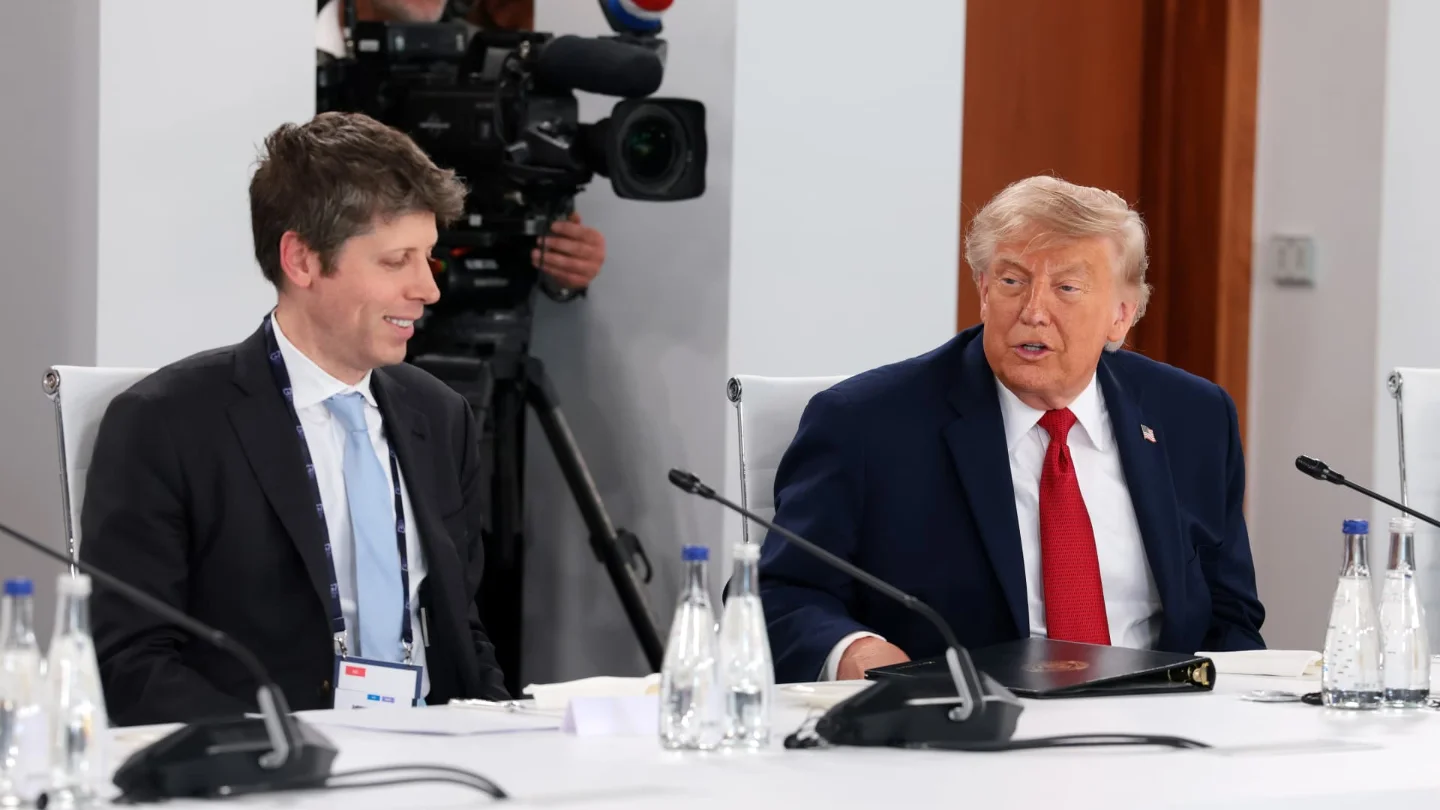
Cover image: Image from CNBC's July 2 report on OpenAI's proposed US government stake.
References
- 1CNBC: OpenAI proposes U.S. government own 5% stake to address political blowback
- 2TechCrunch: OpenAI proposed donating 5% of its equity to a US sovereign wealth fund
- 3Anthropic: Redeploying Fable 5
- 4Fox News / YouTube: The Will Cain Show - Jensen Huang interview
- 5China.org.cn / Beijing Review: More than a market
- 6TechCrunch: What is Mistral AI? Everything to know about the OpenAI competitor
- 7AOL / Business Insider: Alexandr Wang says Meta's finally catching up to OpenAI
- 8Elon Musk on X: Done with Grok Imagine
- 9xAI: Introducing the Voice Agent Builder
- 10The Guardian: OpenAI 'in early talks to give 5% stake to US government'
- 11Axios: OpenAI courts Trump administration as its latest investor
- 12Fortune: Sam Altman seeks new world order for AI
- 13SiliconAngle: Sam Altman calls for US-led international forum to set global AI standards
- 14Business Insider: OpenAI CEO Sam Altman says AI 'will reshape the material conditions of human life'
- 15CNBC: President Donald Trump defends business dealings, his children in CNBC interview
- 16Ars Technica: Trump gets OpenAI to offer US 5% stake, far lower than Sanders' target
- 17CNBC: Anthropic says Trump admin has lifted export controls on Claude Fable 5 and Mythos 5
- 18Anthropic: Fable Safeguards & Jailbreak Framework
- 19Anthropic: Introducing Claude Sonnet 5
- 20Anthropic: Claude Science, an AI workbench for scientists, is now available
- 21Gizmodo: Read the Tense Emails Between the Pentagon and Anthropic
- 22NVIDIA Newsroom: NVIDIA and Corning Announce Long-Term Partnership
- 23NVIDIA Blog: NVIDIA and Partners Build in America, for America
- 24AP News: Nvidia loses its AI chip edge in China
- 25Electrek: Tesla caps employee AI spending at $200/week except for Grok
- 26Tech Times: New Gemini Flash Checkpoint Surfaces on LM Arena
- 27Google DeepMind Blog
- 28Yann LeCun on X
- 29Safe Superintelligence Inc.: Updates
Related content
- Sign in to comment.